Interventional Approaches for Benign Prostatic Enlargement: Non-Surgical Options
Esteemed patients and dear colleagues,
Benign Prostatic Hyperplasia (BPH), also known as benign prostatic enlargement, is a common condition in men that frequently occurs with age and can significantly impact one's quality of life. It can lead to bladder outlet obstruction, causing symptoms such as difficulty urinating, frequent urination, and needing to get up at night to urinate. While traditional treatment methods include medication and surgical options, recent advancements in medicine are increasingly focusing on interventional approaches that offer patients less invasive, more comfortable, and highly effective solutions. As an Interventional Radiology specialist, I closely monitor these developments and am dedicated to providing our patients with the most current treatment options available.
The Role of Interventional Radiology and the Rise of Non-Surgical Treatments
Interventional Radiology is a medical specialty that diagnoses and treats diseases within the body using minimally invasive methods guided by advanced imaging techniques. In the treatment of prostatic enlargement, we offer non-surgical options that enable patients to avoid the risks associated with surgery, prolonged recovery periods, and general anaesthesia complications. These approaches are typically performed under local anaesthesia, significantly shorten hospital stays, and allow patients to return to their daily lives much more quickly.
Prostate Artery Embolisation (PAE): An Innovative and Effective Method
One of the most prominent and effective interventional methods for benign prostatic enlargement, which we successfully employ at our clinic, is Prostate Artery Embolisation (PAE). This non-surgical procedure precisely targets and blocks the arteries that supply blood to the enlarged prostate gland.
How is the PAE Procedure Performed?
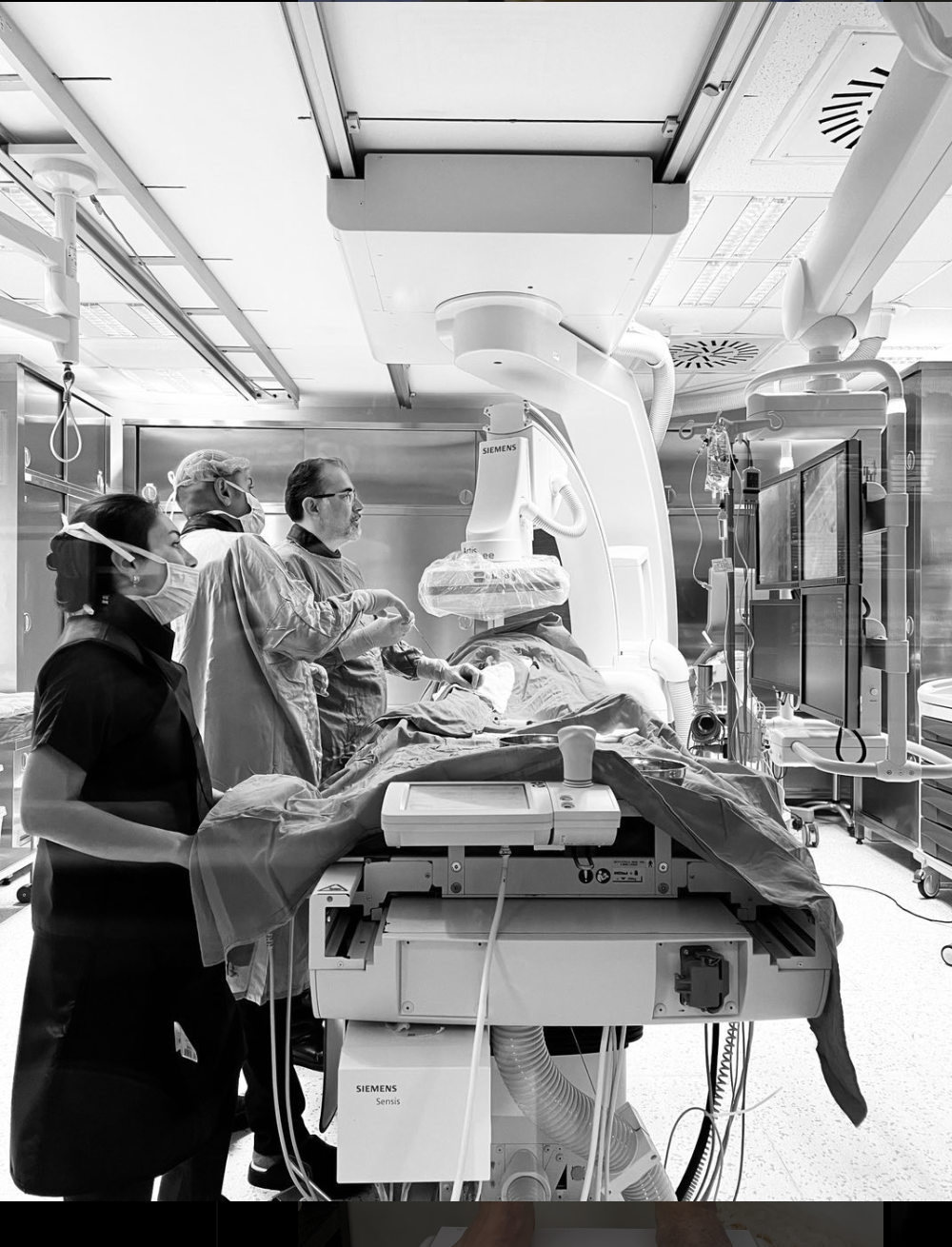
PAE typically begins under local anaesthesia with the insertion of a very fine catheter (tube) into an artery, usually in the groin region. Guided by advanced imaging techniques (fluoroscopy), the catheter is carefully advanced to the specific arteries that supply blood to the enlarged prostate gland. Once these vessels are accurately identified, special microscopic particles (embolic agents), measured in millimetres, are injected to effectively block the arteries. This blockage subsequently reduces the blood flow to the prostate tissue. As blood flow diminishes, the prostate tissue gradually shrinks over time, which in turn alleviates pressure on the bladder and leads to a significant improvement in urinary symptoms. The procedure is usually applied to both prostate arteries and typically takes approximately 1-3 hours to complete.
Advantages of PAE
Prostate Artery Embolisation (PAE) stands out due to a range of significant advantages it offers in the treatment of benign prostatic enlargement. Firstly, as no surgical incisions are made, the risks associated with surgery, such as bleeding and infection, are minimised. The procedure is performed under local anaesthesia, thereby eliminating the risks of general anaesthesia and providing a safe alternative, particularly for patients who may not be suitable candidates for general anaesthesia. Patients can often be discharged the same day or the day after the procedure, which substantially shortens hospital stays and accelerates the overall recovery process.
Other notable advantages of PAE include the preservation of sexual function; risks such as retrograde ejaculation (where semen flows backward into the bladder) or permanent impotence, which can sometimes occur after traditional surgical procedures, are virtually non-existent with this interventional treatment. Furthermore, the risk of urinary incontinence is also very low. This method can prove effective even for patients with considerably large prostates or those who have previously undergone unsuccessful surgical interventions. It also presents a promising and viable option for individuals who have not responded adequately to conventional medical treatments or who are deemed unsuitable for surgery.
Who is PAE Suitable For?
Prostate Artery Embolisation (PAE) is a suitable treatment option for various groups of patients. It is particularly ideal for individuals experiencing moderate to severe urinary tract symptoms whose complaints persist despite medication, or who cannot tolerate the side effects of their prescribed drugs. High-risk patients who may not be able to withstand traditional surgical intervention due to their general health status, those currently taking blood thinners, or individuals for whom general anaesthesia is contraindicated, can often be excellent candidates for PAE. Furthermore, it is an attractive alternative for men who are concerned about potential sexual side effects that can occur after surgery and who wish to preserve their sexual function. Before initiating treatment, the patient's suitability for PAE is meticulously evaluated by us through a detailed urological assessment and advanced imaging tests (such as MRI). For information on our robotic technologies in interventional radiology, please visit our prostate biopsy page.